
ESG Reporting in Saudi Arabia: An Overview Survey Study Against the GRI Framework & Reporting Principles
- Mar, 15, 2026

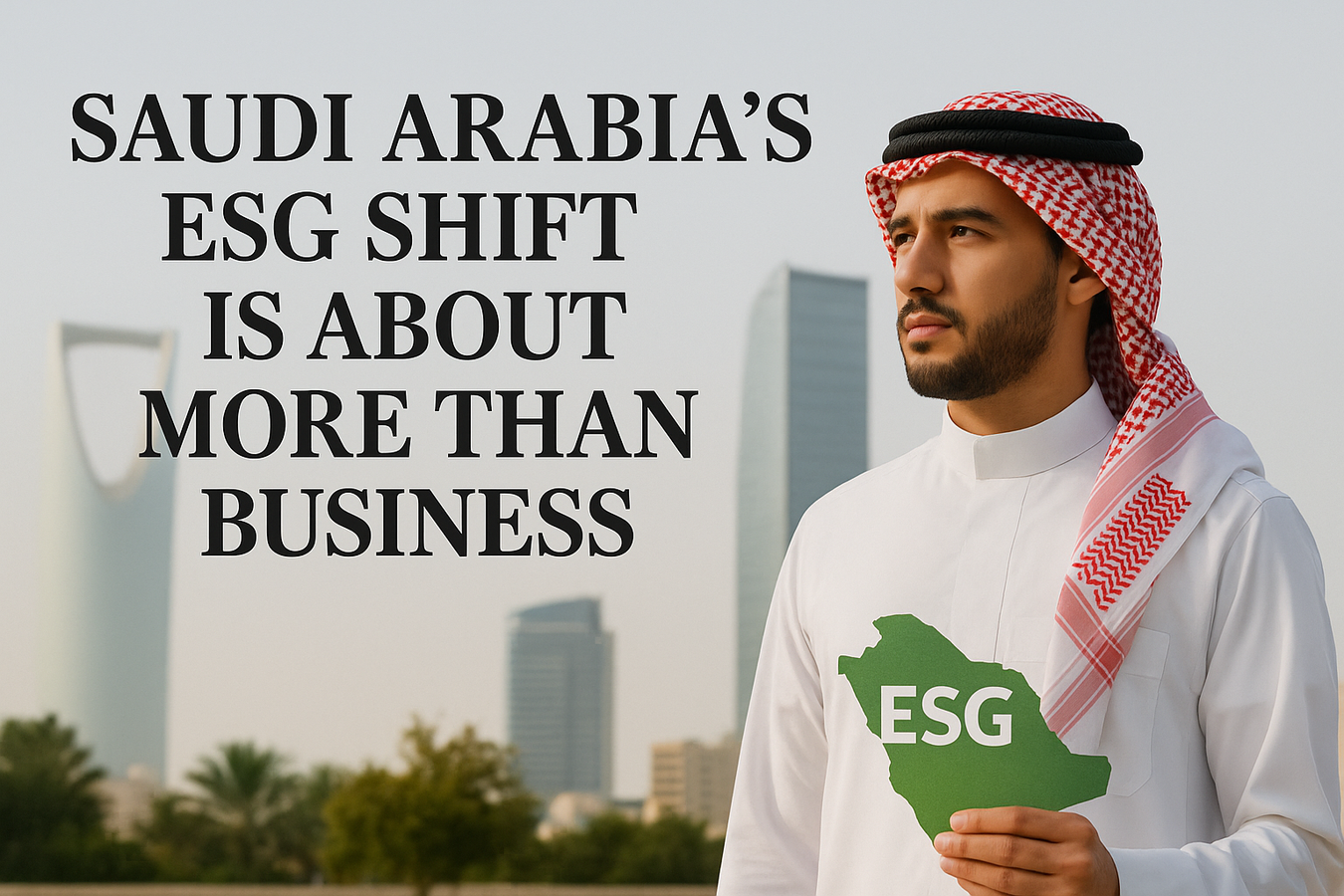
Overview Survey Study — March 2025
This study examines how Saudi Arabian companies align thier ESG Reports with the Global Reporting Initiative (GRI) framework and its core reporting principles, set against the backdrop of Vision 2030 and the Kingdom’s accelerating sustainability transformation.
Executive Summary
Saudi Arabia’s Vision 2030 transformation has fundamentally repositioned ESG from a peripheral concern to a strategic national imperative. This survey synthesises evidence from regulatory developments, corporate sustainability reports, sector analyses, and regional benchmarking data to assess where Saudi companies stand on GRI alignment — covering the four foundational reporting principles (Stakeholder Inclusiveness, Sustainability Context, Materiality, and Completeness) as well as the six quality principles (Accuracy, Balance, Clarity, Comparability, Reliability, and Timeliness).
Key Findings at a Glance
- GRI is the most widely adopted framework among reporting Saudi companies, with over 80% of GRI-utilising firms reporting improved stakeholder trust (2024).
- ESG reporting remains voluntary, with approximately 30% of leading Saudi firms publishing sustainability reports.
- 66% of Middle Eastern companies that produce ESG reports adhere to the GRI framework.
- The Saudi Exchange (Tadawul) issued ESG Disclosure Guidelines in 2021; the Ministry of Economy and Planning has announced unified national ESG guidelines aligned with international norms.
- Key challenges include data quality, qualified human capital shortages, and inconsistent materiality assessment practices across sectors.
1. Introduction
1.1 Background and Rationale
Saudi Arabia, as the world’s largest oil exporter and a G20 member, occupies a unique position in the global sustainability discourse. The announcement of Vision 2030 in 2016 marked a decisive pivot toward economic diversification, social reform, and environmental stewardship — all of which are intrinsically linked to robust ESG reporting.
The Global Reporting Initiative (GRI), founded in 1997, has emerged as the world’s most widely used sustainability reporting standard, currently adopted by 78% of the world’s 250 largest companies. In the Middle East and Africa region, GRI adoption stands at 64% among top reporting companies — a figure that has grown significantly since 2020.
1.2 Study Objectives
- Map the regulatory and institutional ESG reporting landscape in Saudi Arabia
- Explain the GRI framework structure and its foundational and quality reporting principles
- Assess GRI compliance levels and reporting quality across key Saudi sectors
- Conduct a company-level analysis of leading Saudi reporters against GRI principles
- Identify structural challenges and provide strategic recommendations
2. The Saudi Arabia ESG Regulatory Landscape
2.1 Policy and Regulatory Architecture
Saudi Arabia’s ESG regulatory framework is anchored in Vision 2030. The regulatory architecture operates through multiple institutions:
| Institution | Initiative / Guideline | Scope & Status |
|---|---|---|
| Capital Market Authority (CMA) | ESG Disclosure Guidelines (2019) | Listed companies; voluntary; covers governance, environmental & social KPIs |
| Saudi Exchange (Tadawul) | ESG Reporting Framework & ESG Index (2021) | Framework for issuers; launched ESG index to incentivise performance |
| Ministry of Economy & Planning | Unified National ESG Guidelines (announced 2024) | Alignment with GRI, SASB; codification underway |
| Public Investment Fund (PIF) | ESG-integrated Investment Strategy | SAR 700B+ sustainability investments; ESG criteria in portfolio decisions |
| Saudi Green Initiative | National Sustainability Targets | Plant 10B trees; 50% renewable energy by 2030; Net-Zero by 2060 |
2.2 Voluntary vs. Mandatory Status
As of 2025, ESG reporting in Saudi Arabia remains largely voluntary. Approximately 30% of leading Saudi firms already publish full sustainability reports, with a further 24% disclosing selected ESG metrics. Saudi Arabia is in a “pre-mandatory” phase — a critical window for companies to build robust reporting foundations before formal mandates are introduced.
3. The GRI Framework: Structure and Reporting Principles
3.1 The GRI Standards System
The GRI Standards 2021 (mandatory from January 2023) are organised in a three-tier modular structure:
| Standard Tier | Standards Included | Purpose |
|---|---|---|
| Universal Standards | GRI 1, GRI 2, GRI 3 | Apply to all organisations; set principles, reporting requirements, governance disclosures, and materiality process |
| Sector Standards | GRI 11 (Oil & Gas), GRI 12 (Coal), GRI 13 (Agriculture) | Sector-specific likely material topics; critical for Saudi energy and resources sectors |
| Topic Standards | GRI 200s (Economic), GRI 300s (Environmental), GRI 400s (Social) | Detailed disclosures on specific material topics (emissions, water, labour, anti-corruption, biodiversity, etc.) |
3.2 The Four Foundational Reporting Principles
Principle 1: Stakeholder Inclusiveness
Organisations must identify their stakeholders and explain how they have responded to their reasonable expectations. In Saudi Arabia, this requires engagement with employees, investors, local communities, regulators, and international capital markets. A common gap: many Saudi companies default to top-down stakeholder identification rather than genuine two-way engagement.
Principle 2: Sustainability Context
Reports must present performance in the broader context of sustainable development — referencing planetary limits, Vision 2030 targets, and international frameworks (SDGs, Paris Agreement). Saudi Arabia’s targets (50% renewable energy by 2030, net-zero by 2060, 10 billion trees) provide a rich national sustainability context.
Principle 3: Materiality
Under GRI 2021, organisations must conduct an impact materiality assessment — identifying topics where their activities have the most significant economic, environmental, and social impacts. A significant portion of Saudi sustainability reports do not document a rigorous, formally conducted materiality assessment; topics are often selected based on data availability rather than stakeholder-informed impact significance.
Principle 4: Completeness
Reports must include all material topics with sufficient scope, boundary, and time period — covering the entire value chain. Value chain completeness (particularly Scope 3 emissions and supplier ESG practices) remains the most underdeveloped area in Saudi ESG reports.
3.3 The Six Quality Reporting Principles
| Principle | Definition | Saudi Compliance Observation |
|---|---|---|
| Accuracy | Sufficiently precise data for stakeholder assessment | Improving: Large-caps (Aramco, stc) report quantitative KPIs; SMEs remain qualitative-heavy |
| Balance | Must reflect positive AND negative aspects without selective omission | Weakness: Most Saudi reports emphasise achievements; negative impacts rarely disclosed proactively |
| Clarity | Understandable and accessible to all stakeholders | Moderate: Bilingual (Arabic/English) reporting is emerging but not universal |
| Comparability | Consistent methodology across periods for trend analysis | Weakness: Limited multi-year comparability; inconsistent base years and scope boundaries |
| Reliability | Data must be verifiable; third-party assurance strengthens credibility | Developing: External assurance adopted by large-caps (Aramco uses ISAE 3000); absent for mid-caps |
| Timeliness | Reports published regularly and aligned with decision-relevant periods | Acceptable: Most listed companies publish annually; typically 6–9 months post-year-end |
4. Sector-Level GRI Alignment Analysis
Energy & Hydrocarbons
The energy sector — dominated by Saudi Aramco and SABIC — represents the most mature ESG reporting environment in Saudi Arabia. GRI 11 (Oil & Gas Sector Standard 2021) applies directly. Aramco’s 2024 Sustainability Report outlines net-zero Scope 1 & 2 ambitions by 2050, with an interim carbon intensity target of 8.6 kg CO₂e/boe by 2030. GHG reporting follows the WRI/WBCSD GHG Protocol and includes ISAE 3000 limited assurance for key metrics.
Banking & Financial Services
Saudi banks (Al Rajhi Bank, SNB, Riyad Bank) face growing pressure from both domestic regulators and international capital markets. Finance-sector boards are integrating sustainability covenants and ESG ratings into capital strategies, particularly for green bond and sustainability-linked loan issuers. However, formal GRI content indices are rare in Saudi banking reports, limiting structural alignment assessment.
Telecommunications
stc Group is a leading example of GRI-aligned reporting in the non-hydrocarbon private sector. stc publishes annual sustainability reports referencing GRI Standards, disclosing on energy efficiency, digital inclusion, employee welfare, and governance. The sector is strongest in social disclosures (GRI 400-series) but weaker in Scope 3 and supply chain due diligence.
Real Estate & Giga-Projects
NEOM, The Red Sea Project (secured a SAR 14.12 billion green loan), and Amaala represent ESG-embedded development at scale. However, formal GRI reporting for these projects remains limited. Approximately 40% of new Saudi real estate projects have adopted green certification standards, with a target of 60% by 2025.
5. Company-Level Benchmarking: GRI Principles Assessment
Legend: ● Strong ◑ Moderate ○ Weak / Not Evidenced
| GRI Principle | Saudi Aramco | stc Group | SNB | SABIC | ACWA Power |
|---|---|---|---|---|---|
| Stakeholder Inclusiveness | ◑ | ● | ◑ | ◑ | ◑ |
| Sustainability Context | ● | ● | ◑ | ● | ● |
| Materiality | ◑ | ◑ | ○ | ◑ | ◑ |
| Completeness | ◑ | ◑ | ○ | ◑ | ○ |
| Accuracy | ● | ● | ◑ | ● | ◑ |
| Balance | ◑ | ◑ | ○ | ◑ | ○ |
| Clarity | ● | ● | ◑ | ● | ◑ |
| Comparability | ◑ | ◑ | ○ | ◑ | ○ |
| Reliability (Assurance) | ● | ◑ | ○ | ◑ | ○ |
| Timeliness | ● | ● | ● | ● | ◑ |
6. Key Challenges to GRI Compliance in Saudi Arabia
- Human Capital & Institutional Capacity: A persistent shortage of qualified ESG professionals with expertise in GRI standards, materiality assessments, carbon accounting, and stakeholder engagement remains the most critical structural barrier.
- Data Quality & Infrastructure: Many Saudi companies lack the operational data systems needed to collect, validate, and report on environmental metrics across complex multi-site operations or diverse supply chains.
- Materiality Assessment Rigor: Many Saudi reports identify material topics without transparent documentation of stakeholder engagement processes, impact assessment methodology, or basis for topic prioritisation — a fundamental misalignment with GRI 3 requirements.
- Multi-Framework Fragmentation: Companies face competing expectations from GRI, SASB, TCFD, ISSB, and regional Gulf ESG metrics, leading to fragmented reporting that satisfies none completely.
- Greenwashing Risk: A PwC Middle East investor survey (2024) found that 95% of investors covering Middle Eastern companies believe corporate sustainability reporting in the region contains some level of unsupported claims — reflecting a significant credibility deficit.
7. Strategic Recommendations
For Companies
- Conduct a formal GRI 3-compliant materiality assessment with documented stakeholder engagement, and publish the process transparently.
- Adopt GRI Universal Standards (GRI 1, 2, 3) as a baseline before progressing to sector-specific standards (GRI 11 for oil & gas).
- Commission at least limited third-party assurance (ISAE 3000) for key quantitative metrics — particularly Scope 1, 2 emissions and water — to meet the Reliability principle.
- Invest in ESG data management systems that integrate with ERP platforms to improve Accuracy and Comparability across reporting periods.
- Publish GRI content indices to enable stakeholder verification of disclosure completeness.
For Regulators
- Accelerate the finalisation of unified national ESG guidelines with clear GRI alignment, sector-specific guidance, and a phased mandatory disclosure timeline.
- Establish a national ESG reporting platform linked to Tadawul’s disclosure system for centralised data collection and peer benchmarking.
- Develop an ESG capacity-building programme through universities and professional bodies to address the talent gap.
8. Outlook: 2025–2030
| Timeframe | Expected Development | GRI Relevance |
|---|---|---|
| 2025–2026 | Unified national ESG guidelines published by Ministry of Economy & Planning | Direct GRI framework alignment; structured disclosure timelines |
| 2026–2027 | Mandatory ESG disclosures likely for Tadawul-listed companies | GRI Universal Standards adoption as baseline compliance mechanism |
| 2027–2028 | ESG assurance becomes standard practice for large-caps | ISAE 3000 or equivalent assurance aligned with GRI Reliability principle |
| 2030 | Vision 2030 milestone — 50% renewable energy; 30% women in workforce | Materiality and Sustainability Context principles fully testable |
9. Conclusion
Saudi Arabia stands at an inflection point in its ESG reporting journey. The foundational architecture — regulatory guidelines, national sustainability targets, and growing corporate awareness — is in place. What remains to be built is depth: rigorous materiality assessments, third-party assurance, supply chain transparency, and the cultural shift from aspirational narrative to verified, balanced performance disclosure.
The GRI framework provides the most appropriate global standard for Saudi companies navigating this transformation. Companies that invest now in GRI-aligned reporting systems will be best positioned to meet the forthcoming mandatory disclosure environment and to access the growing pool of ESG-oriented global capital that will increasingly define Saudi Arabia’s economic future.
How VerdeVista Can Help
VerdeVista Consulting offers end-to-end ESG reporting services aligned with GRI Standards — from materiality assessments and stakeholder engagement to sustainability report drafting, GRI content index preparation, and third-party assurance readiness. Contact us to discuss your ESG reporting journey.