
What Is an EPD Environmental Product Declaration?
An EPD is an independently verified document that reports the environmental impact of a product across its life cycle, based on a Life Cycle Assessment (LCA). It follows international standards: ISO 14025 for the declaration, ISO 14040 and 14044 for the LCA method, and EN 15804 or ISO 21930 for construction products.
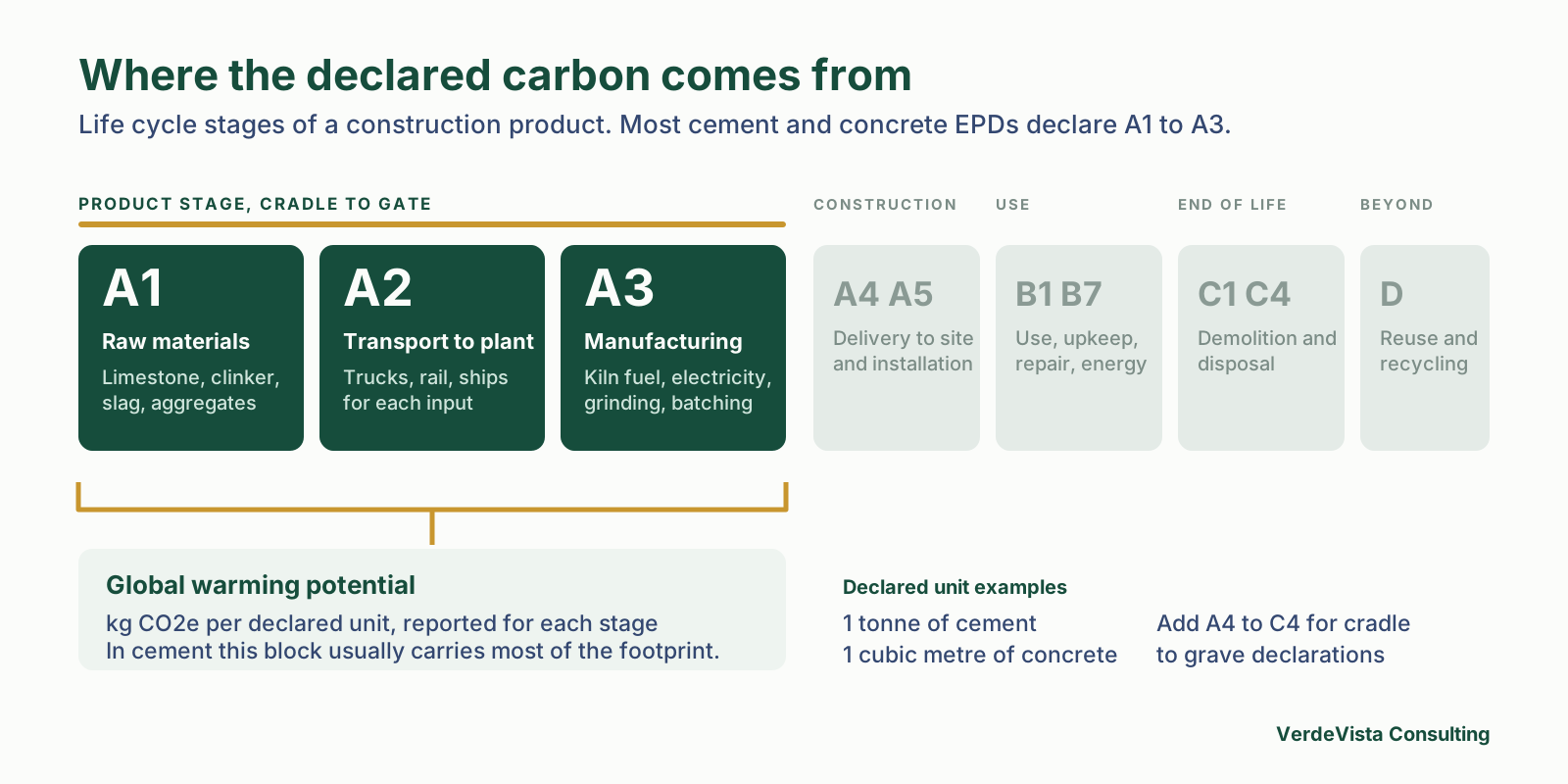
A typical EPD reports, per declared unit such as one tonne of cement or one cubic metre of concrete:
- Global warming potential (GWP) in kg CO2e, split by life cycle stage
- Resource and energy use, renewable and non-renewable
- Water use, waste generation and other impact categories
- Scope and system boundary, such as cradle to gate (A1 to A3) or cradle to grave
The key word is verified. An EPD is not a marketing brochure. It is built on a Product Category Rule (PCR), registered with a program operator and reviewed by an independent third-party verifier. That independence is why procurement teams trust it.
Why EPDs Now Decide Who Wins Sustainable Procurement
Saudi Arabia’s construction pipeline is among the largest in the world, and the volumes of concrete, steel, aluminium and glass involved are enormous. Sustainable procurement is the lever owners use to make those materials cleaner from the start. What this means for suppliers:
- Pre-qualification filters. Developers and main contractors increasingly ask for product-level carbon data before a supplier reaches the shortlist.
- Embodied carbon targets. Contractors need verified numbers to prove they meet project carbon budgets and green building credits.
- Tender scoring. Where carbon data is scored, a supplier with an EPD beats a supplier with only a policy statement.
- Margin protection. Certified low-carbon products are gaining procurement preference while generic products face margin pressure.
Saudi suppliers have already moved. Saudi Readymix published dozens of EPDs across its concrete mixes, and Tabuk Cement became the second company in the Kingdom to obtain an EPD for its cement products, citing demand from NEOM and Amaala. Competitors who wait will be asked for an EPD they do not have.
EPD for Cement and Concrete Producers
Cement and concrete are where the carbon, and the procurement pressure, are concentrated. A well-prepared EPD for these products does more than satisfy a tender checklist. It reveals your clinker factor and the effect of supplementary cementitious materials such as slag, fly ash or limestone, the contribution of fuel mix, kiln efficiency and electricity to GWP, and the difference between mixes, so you can offer buyers a lower-carbon option for each strength class.
Related: see our guide to EPD for ready-mix concrete in Saudi Arabia for mix-level scoping advice.
EPD and CBAM: Related, but Not the Same Thing
The EU Carbon Border Adjustment Mechanism entered its definitive regime on 1 January 2026. Importers of covered goods, including cement, iron and steel, aluminium, fertilisers, hydrogen and electricity, must now buy and surrender certificates linked to embedded emissions, with the first surrender due in 2027. For cement, direct and indirect emissions both count, and actual emissions can only be used in declarations when verified by an accredited verifier. See the European Commission CBAM page for the official rules.
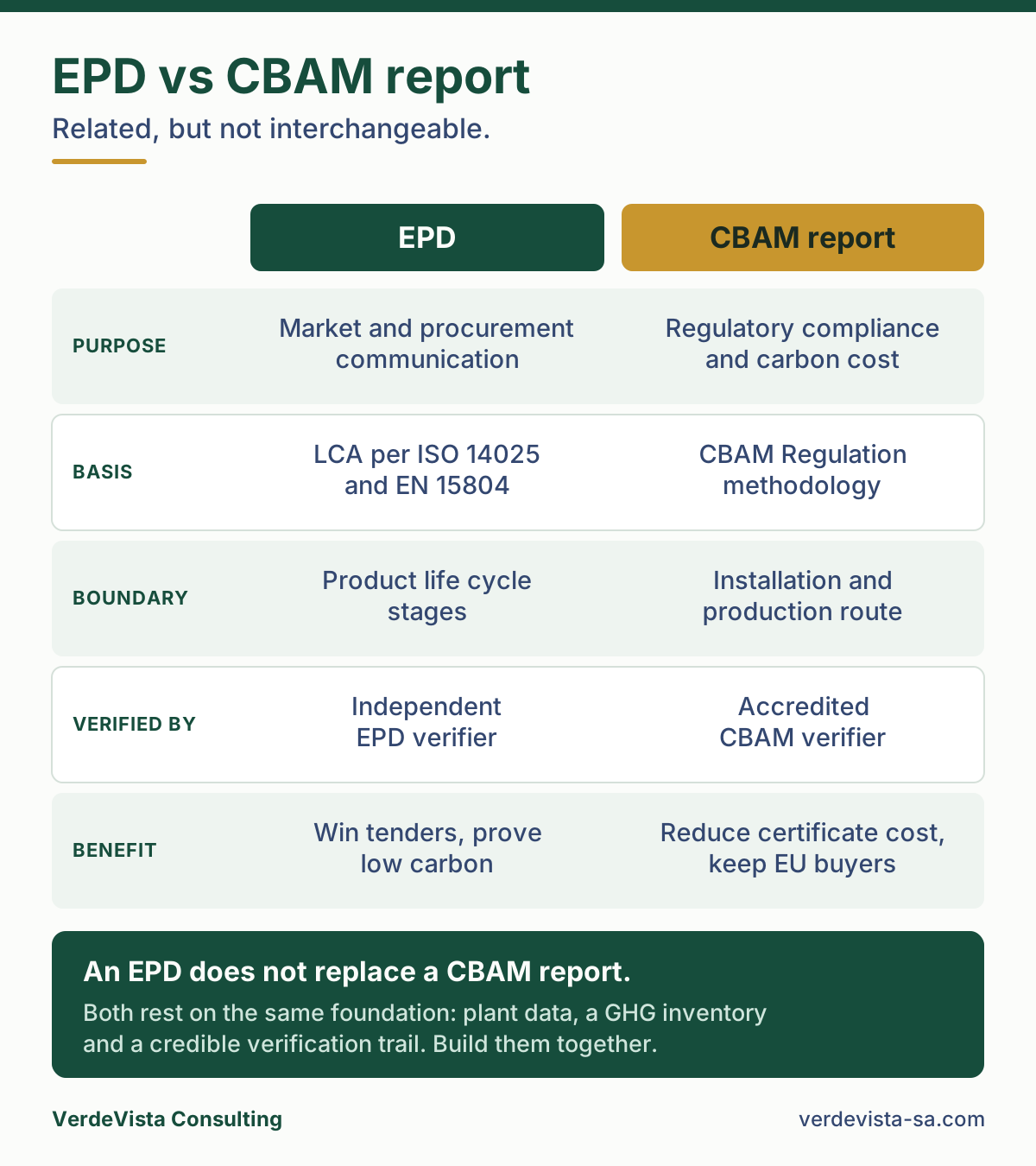
| EPD | CBAM embedded emissions report | |
|---|---|---|
| Purpose | Market and procurement communication | Regulatory compliance and carbon cost |
| Basis | LCA per ISO 14025 and EN 15804 | CBAM Regulation methodology |
| Boundary | Product life cycle stages | Installation and production route |
| Verification | Third-party EPD verifier | Accredited CBAM verifier |
| Main benefit | Win tenders, prove low carbon | Reduce certificate cost, keep EU buyers |
An EPD does not replace a CBAM-compliant emissions report. But the two draw on the same foundation: good plant-level activity data, a solid GHG inventory and a credible verification trail. Building them together avoids duplicated data collection and inconsistent numbers. Learn more about our CBAM compliance services for Saudi exporters and ISO 14064 GHG verification.
From EPD to Supply Chain Carbon Reduction
The real value of an EPD starts after it is published.
- Hotspot analysis. The LCA shows which raw materials, transport legs or energy sources drive your footprint.
- Supplier engagement. You can request primary data from key suppliers and reward those with lower-carbon inputs.
- Scope 3 reporting. Your EPD data feeds your customers’ Scope 3 inventories, which makes you an easier supplier to keep.
- Continuous improvement. EPDs are valid for a limited period, so each renewal becomes a measurable record of progress.
Manufacturers that treat the EPD as a management tool, not a certificate to frame, reduce cost and carbon at the same time.
How to Get EPD Certification: A Practical Roadmap
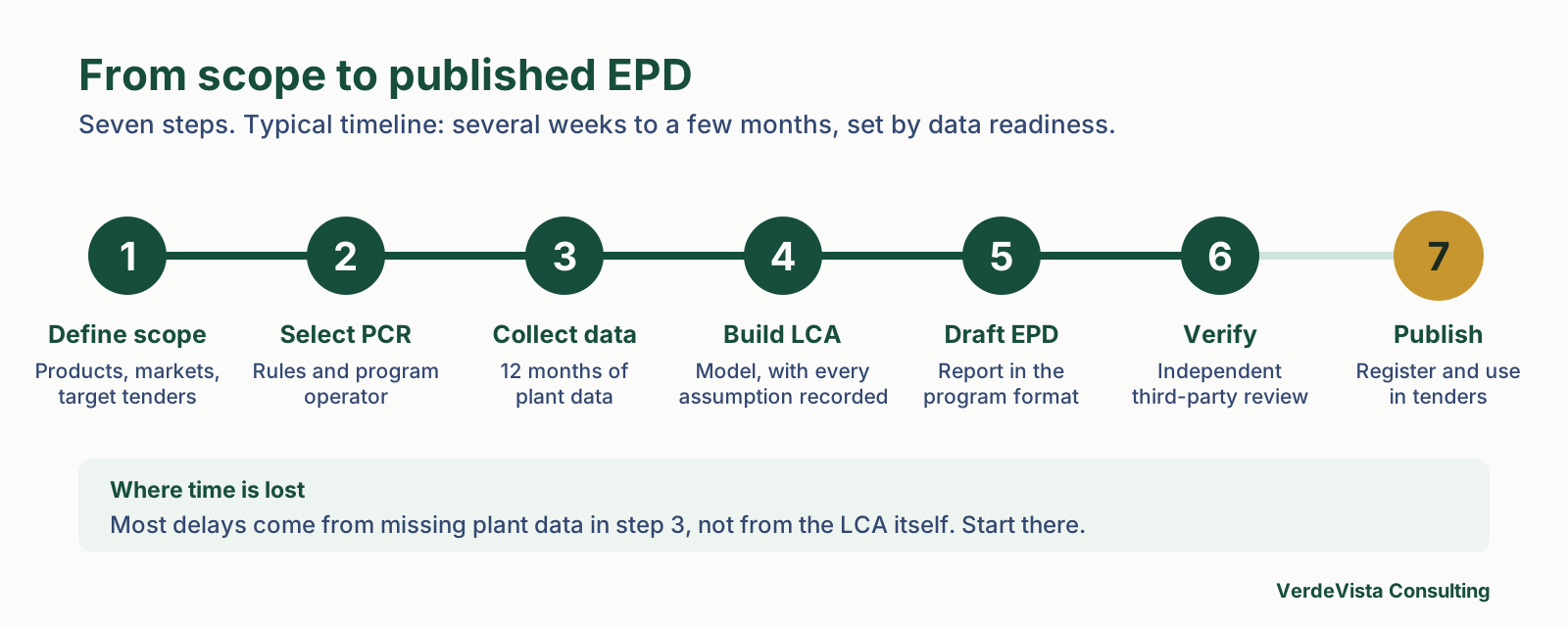
- Define the goal and scope. Which products, which markets, which tenders? Choose the declared unit and system boundary to match what buyers will ask for.
- Select the PCR and program operator. The Product Category Rule fixes the calculation method. Choose a program recognised by your target clients and project owners.
- Collect plant data. Raw material quantities, energy, fuels, water, waste, transport and production volumes for a representative 12 month period.
- Build the LCA model. Use a recognised LCA tool and database, and document every assumption.
- Draft the EPD report. Prepare the background report and the declaration document in the program format.
- Independent verification. A third-party verifier reviews the LCA, the data and the EPD against the PCR.
- Registration and publication. The EPD is registered and published, then used in tenders, product data sheets and sustainability reporting.
Timelines run from several weeks to a few months depending on data readiness. Most delays come from missing plant data, not from the LCA itself.
Common Mistakes to Avoid
- Choosing the wrong PCR or boundary, so the EPD is not accepted by the buyer
- Using generic data where plant-specific data is expected
- Treating the EPD as a one-off instead of planning updates when the process or product mix changes
- Ignoring CBAM and ISO 14064 alignment, which leads to two different carbon numbers for the same plant
How VerdeVista Supports Your EPD Journey
VerdeVista Consulting, based in Riyadh, supports manufacturers, contractors and exporters across Saudi Arabia and the GCC with GHG accounting, ISO 14064 verification, CBAM compliance and sustainability readiness for mega-projects. For EPDs, we help you:
- Identify which products and mixes to declare first, based on your target tenders
- Prepare plant data and the carbon footprint baseline
- Align your EPD scope with CBAM and project sustainability requirements
- Coordinate with the program operator and independent verifier
- Turn results into a supplier carbon reduction roadmap
Ready to qualify for your next sustainable procurement package?
We map the fastest route from your current plant data to a verified EPD, aligned with CBAM and ISO 14064.
Book an EPD readiness consultationFrequently Asked Questions
What is an EPD environmental product declaration?
An EPD is a third-party verified document that reports a product’s life cycle environmental impact, including carbon footprint, based on an LCA and a Product Category Rule. It lets buyers compare products on a consistent basis.
Is an EPD mandatory in Saudi Arabia?
There is no single blanket rule for every product. However, giga-project owners and main contractors increasingly request EPDs or equivalent product carbon data during pre-qualification and tendering, so suppliers without one risk being excluded. Always check the requirements of each tender.
How long is an EPD valid?
Most program operators set a validity of up to five years, provided the underlying data and the product have not changed materially. Check the rules of your chosen program.
Does an EPD satisfy CBAM requirements?
No. CBAM requires embedded emissions to be calculated under its own methodology and, for actual values, verified by an accredited verifier. An EPD supports your carbon data and credibility but does not replace the CBAM report.
How much does EPD certification cost?
Cost depends on the number of products, data quality, the program operator fees and verification effort. A single-plant, single-product EPD is far cheaper than a full mix portfolio, which is why a phased scope is usually the smartest start.
Which products benefit most from an EPD?
Cement, concrete, steel, aluminium, insulation, glass and other high-volume construction materials benefit most, as they carry the largest embodied carbon and receive the most scrutiny in procurement.
Conclusion
In sustainable procurement, the supplier with verified numbers wins over the supplier with good intentions. An EPD environmental product declaration proves your product’s footprint, supports your CBAM and ISO 14064 data, and gives you a clear route to cut supply chain carbon. Start with the products tied to your next tender, build clean plant data, and expand from there.