
Why EPDs Matter in Contractor Procurement
An EPD gives you verified, comparable numbers instead of supplier claims. It supports bid responses, carbon reduction targets in the contract, and credits in green building rating systems such as LEED. It also protects you: if a client audits the carbon of your materials, a verified EPD is the evidence.
What to Ask Suppliers For
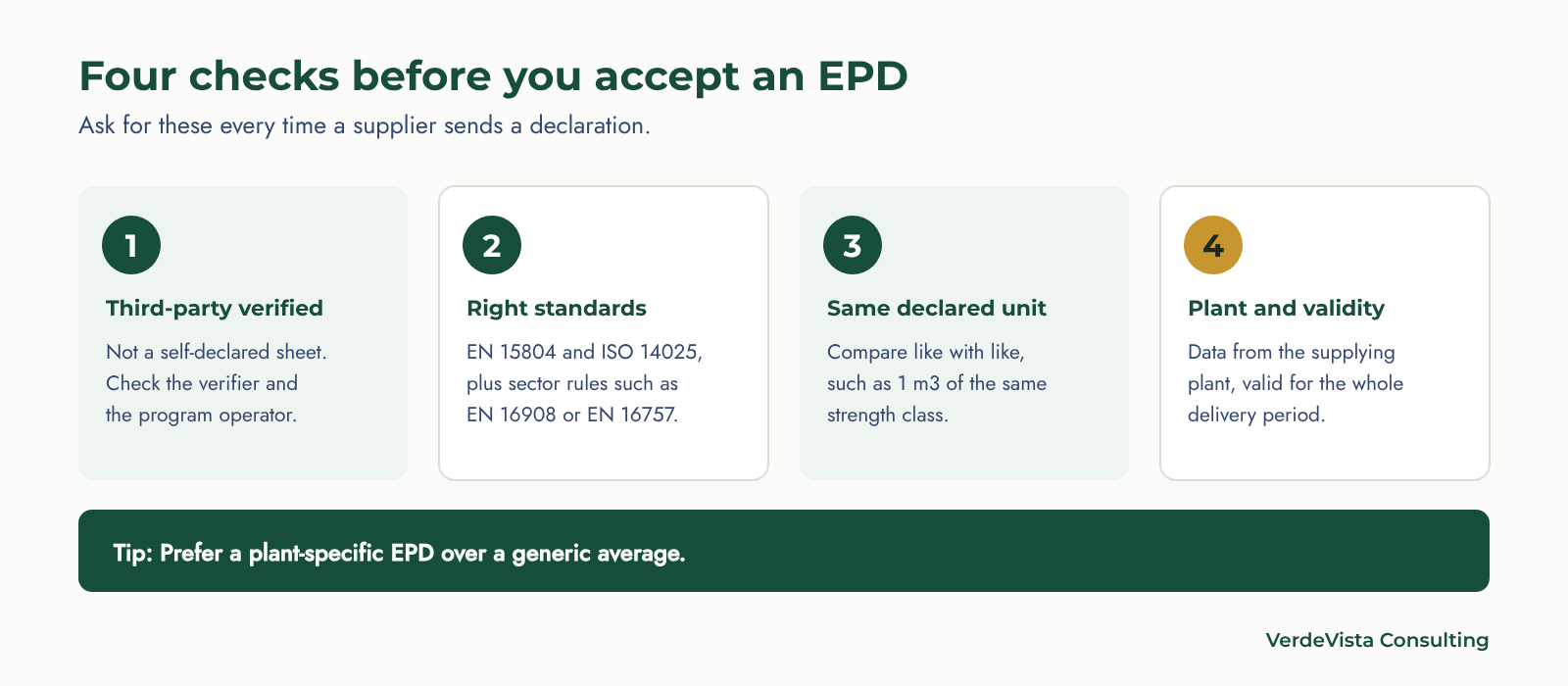
- A third-party verified EPD, not a self-declared sheet
- Compliance with EN 15804 and ISO 14025, plus the sector rules such as EN 16908 for cement or EN 16757 for concrete
- The declared unit and life cycle stages covered (usually A1 to A3)
- Plant-specific data for the plant that will supply your project
- A validity date that covers your delivery period
How to Compare EPDs Fairly
Two numbers are only comparable when they describe the same thing. Check the declared unit, the product category rules, the boundary and the strength class or grade. A lower figure per tonne of cement does not automatically mean a lower figure per cubic metre of concrete, so compare at the level the specification uses. Our guide to ready-mix EPDs and cement EPDs shows what sits behind each number.
Build a Simple EPD Register
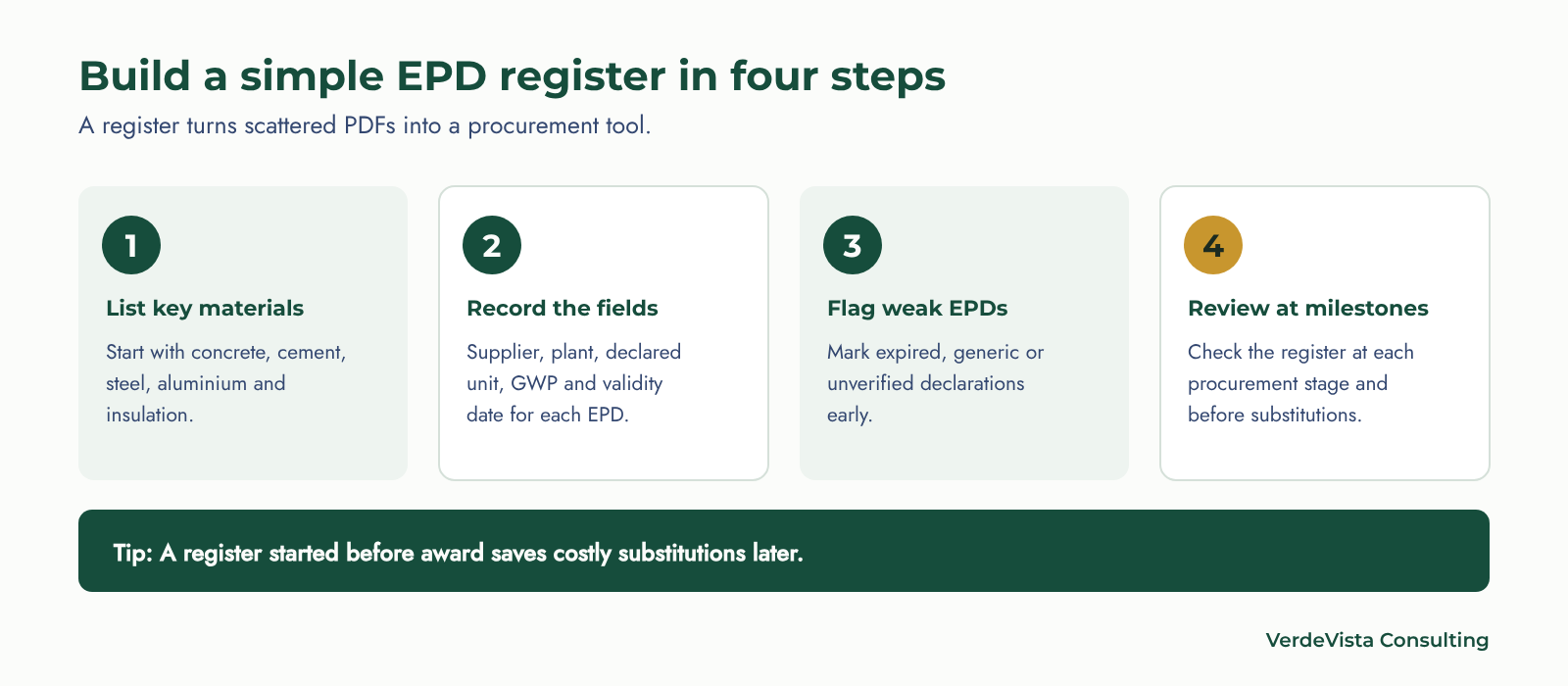
- List the high-volume materials first: concrete, cement, steel, aluminium and insulation
- Record supplier, product, plant, program operator, declared unit, GWP and validity date
- Flag expired, generic or unverified EPDs early
- Review the register at each procurement milestone and before substitutions
Imported Materials and CBAM
If you import materials such as cement, steel or aluminium, or your suppliers export them to the EU, CBAM reporting and EPD data draw on the same plant records. Aligning both early avoids two different carbon numbers for one product. Our CBAM compliance service covers the reporting side.
Common Mistakes Contractors Make
- Accepting a generic or self-declared figure as an EPD
- Comparing EPDs with different declared units
- Letting EPDs expire during a long project
- Collecting EPDs only after award, when substitutions are costly
How VerdeVista Helps
We help contractors and suppliers set EPD requirements for procurement, review supplier declarations, build the register, and prepare producers for their own verified EPDs, alongside GHG accounting and ISO 14064 verification.
Need an EPD procurement checklist for your project? Book a consultation with VerdeVista and we will tailor the requirements and register to your scope.
FAQ
What should a contractor ask suppliers for in an EPD?
Ask for a third-party verified EPD that follows EN 15804 and ISO 14025, states the declared unit, covers the plant that supplies you, and is still within its validity period.
Can contractors compare EPDs from different suppliers?
Only when the declared unit, product category rules and life cycle boundary match. Compare like with like, for example concrete of the same strength class per cubic metre.
Does a contractor need an EPD of its own?
Usually not. Contractors mainly collect and assess supplier EPDs. Manufacturers and producers are the ones who publish them.