
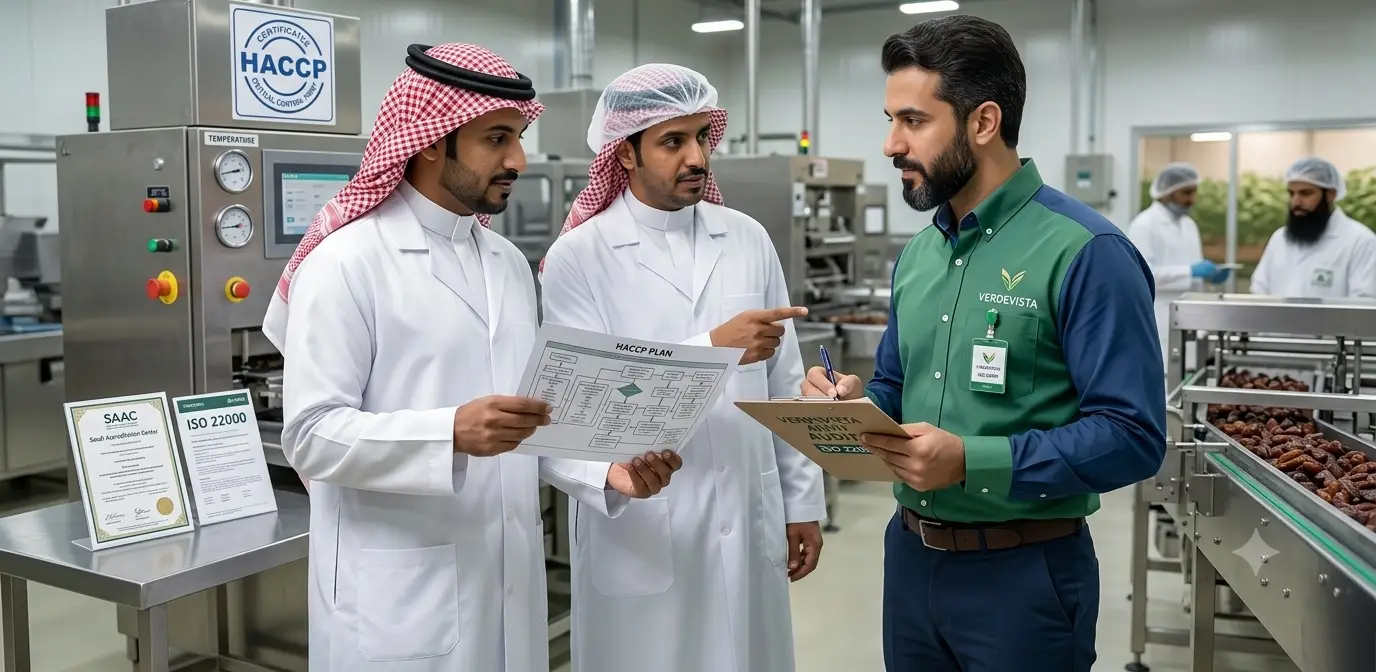
ISO 22000 & HACCP: SFDA Compliance & Implementation Support
- Sep, 08, 2026


Everything Saudi food businesses need for SFDA compliance: core requirements, inspection failures, and the HACCP/ISO 22000 certification process.
Food safety certification in Saudi Arabia has moved from “good practice” to operational necessity. The Saudi Food and Drug Authority (SFDA) has been running sustained, intensive inspection campaigns across the Kingdom — tens of thousands of field visits, thousands of documented violations, and fines running into the millions of Saudi riyals in a single enforcement window. In the most serious cases, facilities have been shut down outright.
This guide brings together everything a food business in Saudi Arabia needs to know in one place: what SFDA actually requires, the most common reasons facilities fail inspections, how the HACCP and ISO 22000 certification process works from gap assessment to certificate, and what to look for in an implementation partner. Before you commit to a certification path, it’s worth confirming your chosen partner is actually recognized — SFDA maintains its own regulations for designating conformity assessment bodies, and working only with an SFDA-approved certification body is what makes the resulting certificate valid and enforceable.
Why SFDA Compliance Is Non-Negotiable Right Now
SFDA has publicly stated it maintains a zero-tolerance policy toward food safety violations, from the factory floor to the point of sale. Its leadership has personally led inspection tours of food facilities, and enforcement teams have the authority to issue fines, demand corrective action within a set timeframe, suspend operations, or close a facility for serious or repeated violations.
The pattern in SFDA’s own reporting is consistent — and reassuring in one sense: the most common issues aren’t exotic contamination events. They’re structural, predictable, and entirely preventable with the right systems in place. This shift mirrors a wider move across Saudi regulatory frameworks toward mandatory, auditable compliance — see our overview of ESG reporting requirements in Saudi Arabia for how the same pattern is playing out in sustainability disclosure.
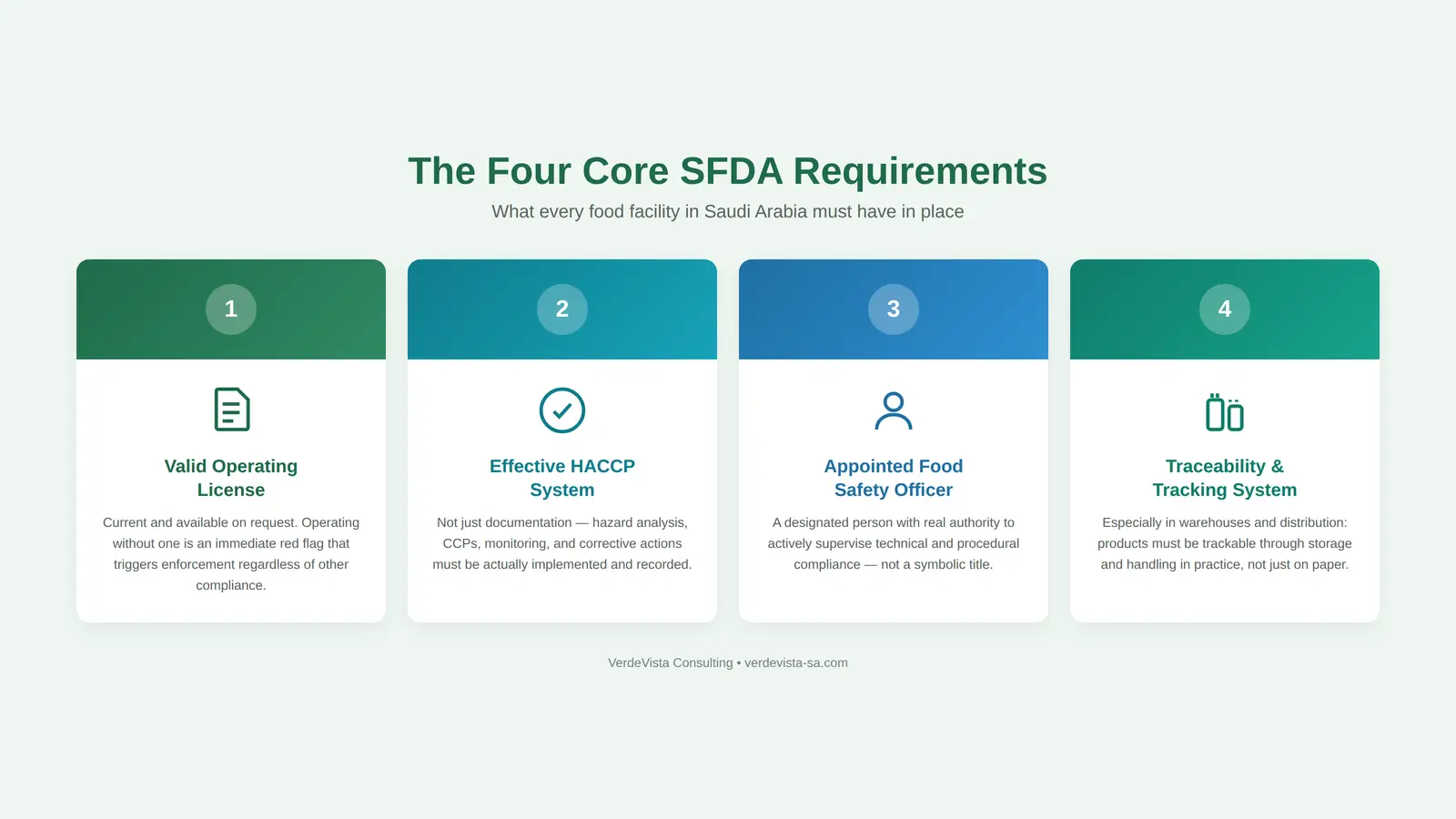
Part 1: The Four Core SFDA Requirements
1. A Valid Operating License
Every food facility under SFDA’s supervision needs a current, valid operating license. During recent inspection campaigns, a meaningful share of facilities visited were found to be operating without one — an immediate red flag that triggers enforcement action regardless of any other compliance issue.
2. An Effective HACCP System
This is the requirement SFDA cites most often in its violation reports — and the distinction that trips facilities up is between having HACCP documentation and running an effective HACCP system. Inspectors check whether hazard analysis, critical control points, monitoring procedures, and corrective actions are actually being implemented and recorded, not just written down once and filed away.
3. An Appointed Food Safety Officer
SFDA requires food facilities to appoint a designated Food Safety Officer responsible for overseeing compliance. This isn’t a symbolic title — the officer is expected to actively supervise implementation of technical and procedural requirements, and SFDA has issued specific guidance on the conditions for this appointment.
4. A Traceability / Tracking System
Especially in warehouses and distribution centers, SFDA inspectors specifically check for an effective system to track products through storage and handling. A system that exists on paper but isn’t followed in practice is flagged in the same violation category as a missing HACCP system.
What SFDA Inspectors Actually Check
Based on SFDA’s own reporting, field teams typically assess:
- Storage and hygiene conditions — handling and storage practices that prevent contamination
- Documentation availability — HACCP records, licenses, and traceability logs accessible during unannounced visits
- Staff awareness and training — whether production and kitchen staff understand food safety requirements relevant to their roles
- Product labeling and expiry controls — expired or mislabeled products are a recurring violation category
Self-Audit Checklist

Part 2: Seven Reasons Facilities Fail Inspections — Beyond the Four Pillars
Beyond the core requirements above, three additional patterns show up consistently in SFDA’s enforcement reporting:
Poor hygiene and unsafe operating practices. In documented cases, inspectors have found conditions conducive to pathogen growth — poor equipment hygiene and unsafe handling capable of supporting harmful bacteria linked to serious illness. This has led to facility shutdowns in the most severe cases.
Expired or mislabeled products. Products past their expiry date remaining in active storage or sale areas, or labeling that doesn’t meet SFDA’s requirements, is one of the easiest issues to catch internally — and one of the most avoidable to have an inspector catch first.
No internal audit or corrective action process. Facilities that never self-check are the ones most likely to be caught off guard. An internal audit is essentially a dry run of what an SFDA inspector will look for, done in a controlled setting with time to fix what’s found.
What Happens If You’re Found Non-Compliant
Consequences scale with severity. Minor documentation gaps typically result in a corrective action notice with a deadline to fix them. More serious or repeated violations — especially those tied to contamination risk — can result in significant fines, with penalties for the most severe violations under the Food Law and its implementing regulations reaching into the tens of millions of riyals, alongside possible operational suspension. Where public health is genuinely at risk, SFDA has moved to close facilities outright.
HACCP Implementation & SFDA-Approved Certification Guidelines
A practical reference aligned with SFDA requirements, Codex Alimentarius, and ISO 22000:2018 — built for food businesses in Saudi Arabia.
- The 12 Codex steps to HACCP, explained
- ISO 22000:2018 FSMS structure, clause by clause
- SFDA-specific certification requirements
- Step-by-step path to SAAC-accredited certification
- Full self-audit checklist included
We’ll only use your details to send you this guide and relevant food safety updates. No spam.
Part 3: The HACCP & ISO 22000 Certification Process
If a gap assessment reveals you need to build or formalize your system, here’s the real implementation sequence — from first assessment to a recognized certificate.

Step 1: Gap Assessment Against Current Operations
An honest, structured review of your current hygiene practices, documentation, and processes against HACCP/ISO 22000 requirements — identifying the hazards specific to your product lines. This step determines the scope of everything that follows.
Step 2: Build the HACCP Plan and Prerequisite Programs (PRPs)
- Hazard analysis — identifying where hazards can enter your process
- Critical Control Points (CCPs) — the points where control is essential
- Critical limits — measurable thresholds that define safe operation
- Prerequisite Programs — sanitation, pest control, supplier approval, equipment maintenance, staff hygiene
A HACCP plan built on weak prerequisite programs tends to collapse under audit scrutiny.
Step 3: Documentation and Monitoring Procedures
Standard operating procedures, real-time monitoring logs, and corrective action records. Auditors specifically look for consistency between what your documents say should happen and what your records show actually happened — this is where many facilities lose points.
Step 4: Staff Training
Role-specific training so the people running the system understand it — auditors frequently interview staff directly to confirm this, not just management. This also connects to your Food Safety Officer’s oversight role.
Step 5: Internal Audit and Corrective Actions
A dry run of the certification audit, done internally, with time to close gaps before an external body finds them.
Step 6: Choosing a SAAC-Accredited Certification Body
A certificate is only as credible as the accreditation behind it. In Saudi Arabia, that means confirming your certification body is accredited by SAAC (the Saudi Accreditation Center) — a certificate from a non-accredited body risks rejection by SFDA or by buyers who specifically require accredited certification.
The audit itself typically runs in two stages:
- Stage 1 (readiness review) — the certification body reviews your documented system to confirm readiness and flags major gaps upfront
- Stage 2 (on-site audit) — auditors observe real production and handling processes, review monitoring records against practice, and interview staff
Once both stages are passed, the certificate is issued — typically valid for a fixed period, with periodic surveillance audits required to maintain it.
Typical Timeline
Timelines vary by facility size and starting point. A smaller, well-prepared single-site operation might move through the full process in a few months; a larger, multi-site manufacturer building a system from a low starting point should expect a longer runway to properly build, train, and stabilize the system before it’s audit-ready.
What Can Delay Certification
- Documentation that doesn’t match actual practice
- Staff who can’t demonstrate understanding during interviews
- Unresolved non-conformities carried over from Stage 1
- Prerequisite programs treated as an afterthought rather than a foundation
Frequently Asked Questions
Do all food businesses need HACCP, or only manufacturers?
HACCP requirements apply broadly across the food chain SFDA supervises — manufacturing, processing, catering, and storage/distribution — not just large-scale manufacturers. Scope and complexity vary by business type and size.
Who can be appointed as a Food Safety Officer?
SFDA has published specific guidance on this role’s requirements. In practice, it should be someone with sufficient authority and food safety knowledge to actively oversee compliance.
How long does HACCP or ISO 22000 certification take?
It depends on your starting point and facility complexity — from a few months for smaller, well-prepared operations to significantly longer for larger or multi-site facilities building a system from scratch.
What happens if we fail the Stage 2 audit?
The certification body documents the non-conformities and typically allows a defined period to correct them before re-assessment — which is why a thorough internal audit beforehand matters.
Do we need to renew certification?
Yes. Certificates are issued for a fixed validity period and require ongoing surveillance audits, and eventual recertification, to remain valid.
What’s the maximum penalty for food safety violations in Saudi Arabia?
Under the Food Law and its implementing regulations, the most severe violations can carry fines reaching into the tens of millions of riyals, operational suspension, or in serious cases, imprisonment.
Part 4: Getting Certified the Right Way — Implementation Consultancy
Every step above can be handled internally with enough time and expertise, or with an experienced partner who has been through the process before. VerdeVista Consulting provides hands-on ISO 22000 and HACCP implementation consultancy for food manufacturers, processors, caterers, and supply chain operators across Saudi Arabia — built around SFDA’s actual requirements, and delivered through partnerships with SAAC-accredited certification bodies only. Many food facilities pursuing ISO 22000 also hold or plan to pursue ISO 9001 certification alongside it, since the two management systems share a common structure and can be implemented together efficiently. Many food businesses pursuing certification are also navigating broader compliance demands that extend beyond food safety — from quality management to GHG verification and adaptation planning, as Saudi regulatory and buyer expectations converge on auditable compliance across the board.
- Gap assessment against ISO 22000, HACCP, and SFDA requirements
- Documentation development — HACCP plan, PRPs, SOPs, monitoring systems — tailored to your actual operations
- Role-specific staff training
- Internal audit and corrective action support
- Certification body selection and audit liaison through Stage 1 and Stage 2
Why VerdeVista: Engagements are led personally by Eng. Abdualhafieth Shareef, Director General, whose credentials include ISO 14064 Lead Verifier, PMP, LEED AP, NEBOSH, Cambridge Circular Economy certification, and Six Sigma Master Black Belt. VerdeVista’s client base spans major Saudi giga-project ecosystems — including supply chain contractors and Aramco-tier suppliers — giving direct experience with the standards large-scale buyers and regulators actually enforce. We work only with SAAC-accredited certification body partners, so the certificate you end up with is one SFDA and your buyers will recognize.
The Bottom Line
The four pillars — a valid license, a genuinely effective HACCP system, an appointed Food Safety Officer, and real traceability — cover the majority of what SFDA inspectors check for. Most violations aren’t the result of bad intent; they’re the result of systems built once and never maintained. If a self-audit against this guide raises more questions than it answers, a structured gap assessment is the logical next step — before your next inspection, not after.
Request a consultation to scope a gap assessment or full implementation engagement for your facility.
Request a Consultation