
The Advertised Landfill: How Advertising Manufactures a Global Waste Crisis
- Aug, 07, 2026

THE ADVERTISED LANDFILL
How the architecture of modern advertising is silently engineering a global waste crisis — and what circular business strategy must do to break the cycle.
The Purchase You Never Needed Is Already on Its Way to the Bin
You did not go to the mall to buy anything. You were passing through when a cascade of colour at a shop window froze your stride. A bold numeral — 60%, 70% OFF — landed on your retina and, within seconds, something older and more powerful than reason took over. You bought it. It sits at home now, tags still on, quietly awaiting the bin. This is not a failure of character. It is the precise, intended outcome of a multi-trillion-dollar industry engineered to intercept the human mind before it can form a full thought.
This investigation examines the psychological mechanisms through which advertising — in physical retail environments, on social media, in digital ecosystems — manufactures desires that bypass genuine need, the measurable contribution of those manufactured desires to urban waste streams, and the responsibility that businesses and their advisors carry to arrest this cascade through genuinely circular strategies.
The advertising message can cause a certain psychological influence that motivates individuals to desire and, consequently, buy a certain product — often without reflecting on why.
Wired to Want: How Advertising Hijacks the Buying Decision
Consumer neuroscience has established with remarkable consistency that the act of making a purchase does not begin with a rational evaluation of need. It begins with a stimulus — visual, auditory, or social — that activates the brain’s reward pathways before conscious deliberation can intervene. Advertising, at its most sophisticated, is the science of engineering those stimuli at scale.
The Discount Trigger and the Scarcity Illusion
Physical retail environments are architected around this vulnerability. Discount signage, bright colour contrasts, product placement near entry points and checkout counters — each element is calibrated to produce what psychologists term an “urge to buy impulsively”: a sudden, powerful motivation to acquire something without pre-intention.
40% of consumers spend more money than planned in physical retail environments, compared with 25% in online channels. The gap is attributed to the immediacy of sensory stimulation.
Research in Humanities and Social Sciences Communications (Nature) identifies that creative advertising — through visual originality, storytelling, and emotional resonance — significantly amplifies impulsive purchase intention.
Time Pressure and the FOMO Architecture
The most deliberately manufactured psychological lever in the modern advertising toolkit is artificial urgency. Flash sales, countdown timers, “only 3 left in stock” notifications — these tactics activate what researchers call Fear Of Missing Out (FOMO): acute anxiety triggered by the perception that a desirable opportunity is about to expire.
Digital marketing strategies leveraging limited-time offers and social proof mechanisms create heightened urgency, causing consumers to make purchase decisions with reduced rationality.
Time-pressure tactics are especially effective on mobile and e-commerce platforms, where the gap between stimulus and transaction has been reduced to a single tap.
Low Self-Control and the Targeted Algorithm
A landmark 2024 study from the University of Jyväskylä — surveying 2,318 young adults — revealed a critical variable: self-control. Consumers with lower self-control not only purchase impulsively at higher rates; they also perceive targeted digital advertisements as more personally relevant.
Low self-control leads directly to impulse buying influenced by social media and targeted advertising. Researchers note the waste and carbon footprint from unnecessary consumption represent a measurable environmental burden.
The Saudi Arabian context adds a specific dimension. A study in Cogent Business & Management (2023) found that social media communities and targeted advertising are reshaping buying preferences among Saudi consumers. For Riyadh, Jeddah, and Dammam, the convergence of ambitious mall development and algorithmic advertising is a structural driver of unnecessary acquisition.
The Landfill Consequence: What Advertising Manufactures Beyond Products
The psychological phenomena described above do not remain in the domain of consumer psychology. They have a physical terminus: the landfill, the incinerator, the illegal dump. The causal chain from advertising-induced impulse purchase to urban waste generation is well-documented in scientific literature, and the resulting crisis constitutes one of the defining environmental challenges of the century.
The Scale of the Crisis
According to UNEP and ISWA’s Global Waste Management Outlook 2024 — the most authoritative global synthesis of MSW data — the world generated 2.12 billion tonnes of municipal solid waste in 2023. That figure is projected to grow by 80% to 3.78 billion tonnes annually by 2050 under business-as-usual.
In 2020, only 19% of municipal solid waste was recycled globally. Nearly 38% was improperly disposed of through open dumping or burning. Direct costs of waste management were $252 billion in 2020 — projected to reach $640 billion annually by 2050.
The Advertising-Waste Link: Direct Evidence
Research in Frontiers in Sustainable Food Systems found that impulse buying triggered by promotional advertising creates a paradoxical outcome: while promotions may reduce food waste at the retail level, excessive purchases induced by price reductions result in more unconsumed food at the household level.
An increase in impulse buying may offset the positive effect of promotional food consumption on waste reduction. The study identifies a direct mediating pathway between advertising-triggered impulse buying and downstream waste generation.
The fast fashion and electronics sectors represent the most extreme manifestations. Over 40 million tonnes of e-waste is generated globally each year (World Economic Forum).
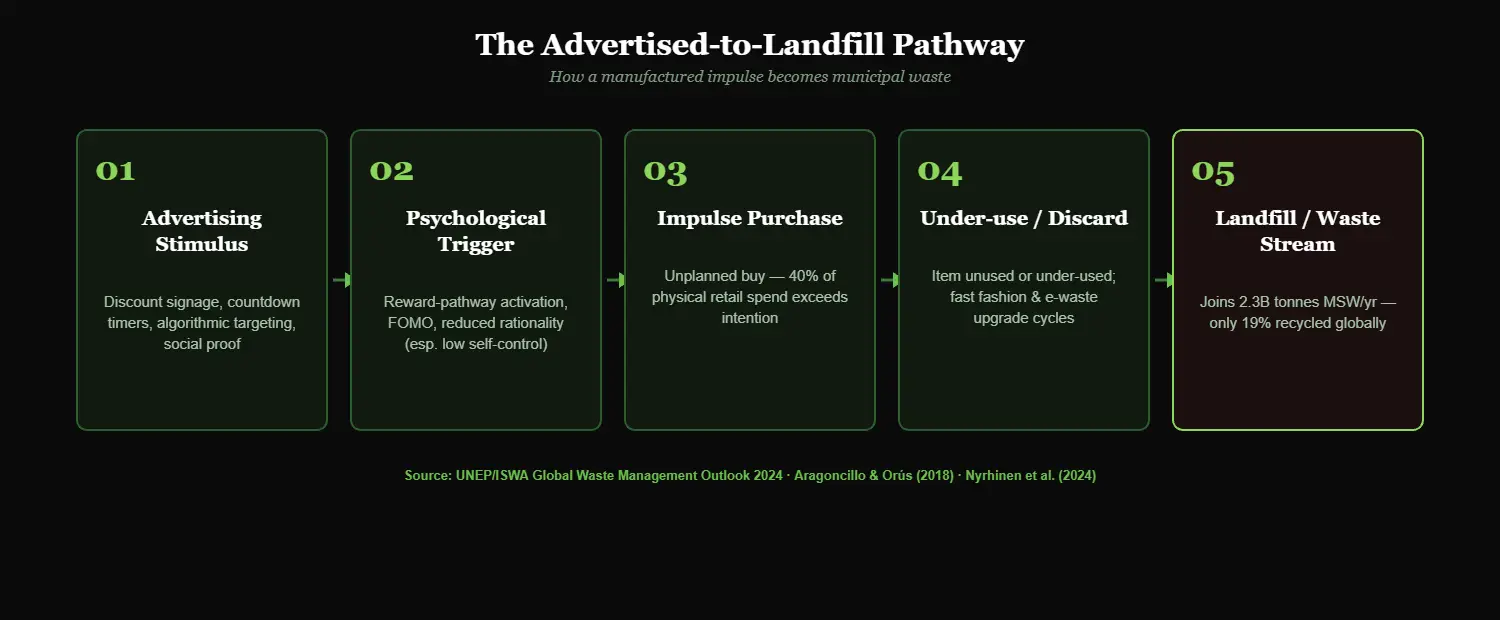
Impulse buying contributes to overconsumption and the generation of unnecessary waste. When people buy things on a whim, they are less likely to consider the environmental impact of the product.
Breaking the Cycle: Circular Economy as a Business Imperative
The waste crisis described above is not an inevitability. It is the predictable output of the linear “take-make-dispose” model operating alongside an advertising industry whose incentives are structurally misaligned with environmental outcomes.
What the Circular Economy Actually Changes
Circular economy (CE) models redesign the relationship between production, consumption, and material recovery. The Ellen MacArthur Foundation estimates circular business models could generate $1 trillion in material savings annually by 2030. Businesses implementing circular strategies see average profit margin increases of 23% within three years.
The Role of Advertising in Circular Transition
Marketing’s historical role has been to persuade people to buy more. In a circular economy, it must instead build long-term relationships and make circular behaviour — repair, resale, return — aspirationally compelling. Patagonia’s Worn Wear programme repaired 130,000 items in 2024.
How VerdeVista Embeds Circularity Into Business Strategy
VerdeVista Consulting is a Riyadh-based sustainability advisory firm specialising in GHG accounting, third-party verification (ISO 14064), and environmental consulting for Saudi Arabia and the GCC. Across the Kingdom’s giga-project supply chains — NEOM, Red Sea Global, Qiddiya, Diriyah Gate — VerdeVista provides the technical rigour required to transition from linear to circular business models.
Mega-project supply chains generate consumption at a scale that makes advertising-induced over-procurement a significant operational liability. VerdeVista’s MSR framework embeds circularity requirements into procurement governance from the earliest project phases.
The Waste Begins With the Advertisement
The landfill does not begin at the kerbside. It begins — much earlier, and much more deliberately — at the moment an advertisement successfully manufactures a desire for something its target audience does not need. Discount triggers, FOMO architecture, algorithmic targeting, social proof mechanisms — each is a precision tool designed to intercept cognition before need can be assessed.
The consequences accumulate at urban scale. A planet generating 2.3 billion tonnes of municipal solid waste annually, projected to grow by 80% in less than three decades, cannot sustain a commercial model whose logic is to continuously expand the volume of goods acquired and discarded.
The response is not the abolition of advertising. It is the transformation of what advertising promotes and how businesses design their relationships with material goods. Businesses that embed circularity at the strategic level are restructuring their cost base and positioning for a market in which 73% of consumers already state that environmental impact influences their purchasing decisions.
The planet, the economy, and society can no longer support the ‘take, make, waste’ model. Marketing’s role must shift from persuading people to buy more, to building long-term, meaningful relationships.
The advertised landfill is not inevitable. It is a choice — made at the boardroom level, repeated at the checkout, and accumulated at the city’s edge. Changing that choice is the work of circular strategy. It is the work VerdeVista exists to do.